For most of the generative AI cycle, AI products were essentially chat interfaces. You opened a window, asked a question, and the model replied. In that world, the obvious path to improvement was waiting for a better model. Better reasoning, larger context windows and stronger instruction-following all translated directly into a better user experience.
That made sense while the model was still the main constraint. But the landscape has changed. Models are now broadly good enough for a huge range of business problems. They are not perfect, and model choice still matters, but the biggest limitation is no longer raw intelligence. The bigger question is whether the model has the right context, tools and controls around it to do useful work.
This shift became clear in late 2025 as coding tools such as Codex and Claude Code became materially more capable. These tools were not just better chatbots for developers. They could inspect a codebase, understand the structure of a project, edit files, run commands, check errors, use feedback and continue working through a task. The important change was not only the model. It was the system around the model.
That system is known as the harness.
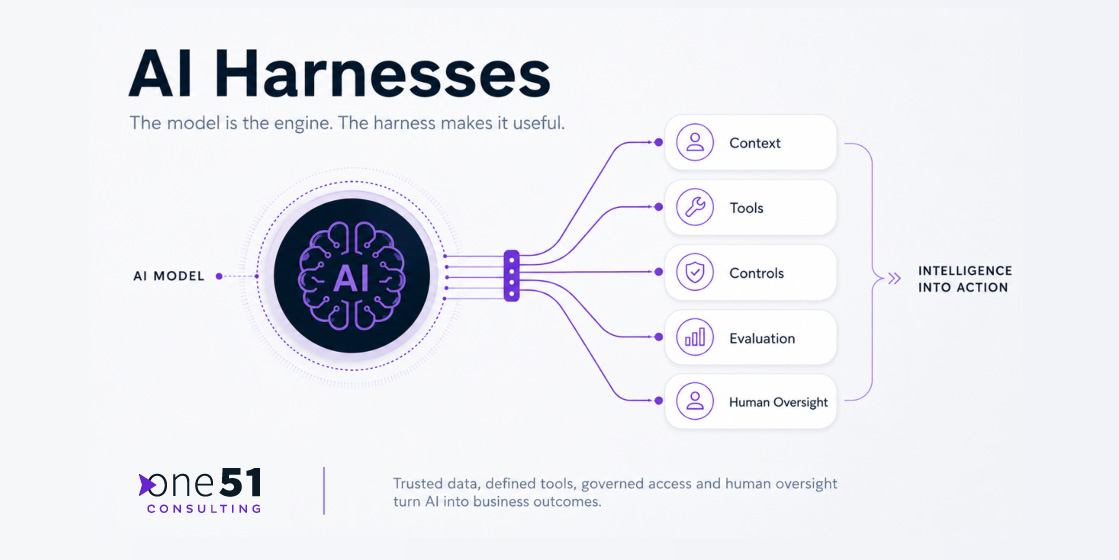
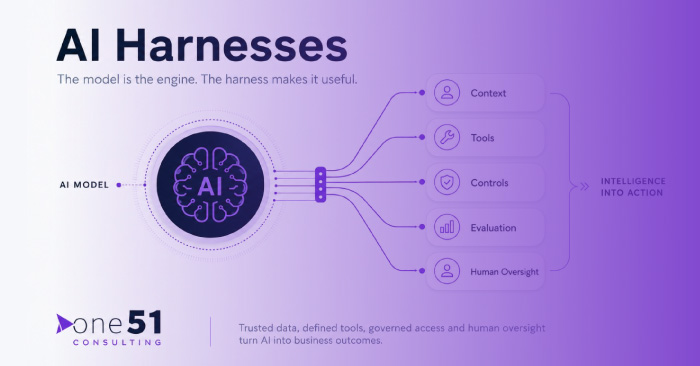
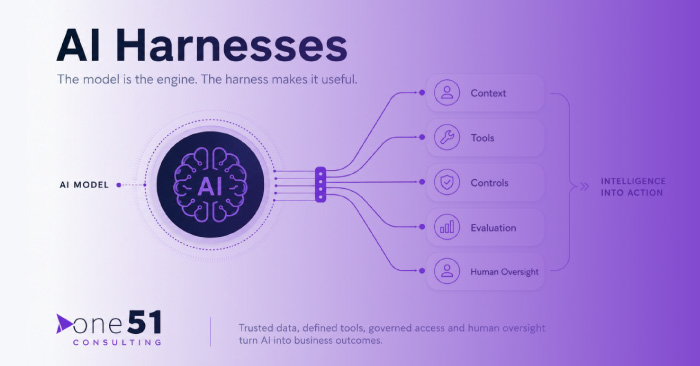
To borrow an analogy from a recent vscode article, think of the model as the engine and the harness as the car. The engine provides power, but the car makes that power usable. It adds steering, brakes, controls, safety systems, navigation, feedback and a connection to the road. Without the car, the engine is impressive but limited. With the car, the power can be directed towards a practical outcome.
In AI terms, the harness decides what context the model sees, which tools it can use, what actions it is allowed to take, how work is orchestrated across steps or specialist sub-agents, how results are checked, when it should continue, retry or stop, and when a human needs to step in. That is why harness engineering is becoming so important. The model provides reasoning, but the harness turns that reasoning into useful action.
Early AI MVPs often struggled because they were built around the model rather than the harness. They treated AI as a smarter chat interface, with retrieval or tool access added around the edges. The development approach is different now. Agentic solutions need to be designed around the harness first: the operating layer that gives the model context, constrains its actions, manages the workflow, checks progress, handles failure and decides when a person should take control.
This is where platforms like Azure AI Foundry and Databricks become important. Azure AI Foundry is becoming a practical environment for building and operating agentic solutions. AI Foundry Hosted agents provides a simple way to develop agents that can inspect inputs, work with files, call approved tools, follow defined instructions and continue through multi-step tasks in a managed environment with strong control over identity, deployment, observability and governance.
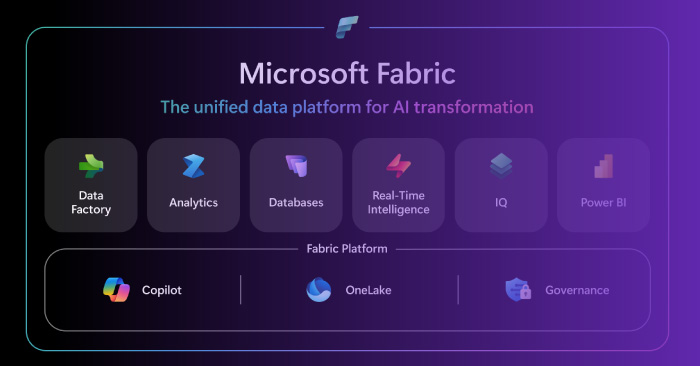
For organisations already invested in Microsoft, Foundry becomes even more valuable alongside Fabric, Microsoft 365 and Microsoft IQ. Fabric can provide governed data and semantic models. Work IQ, Fabric IQ and Foundry IQ point towards agents that understand business context. This is the foundation required for agents that can operate safely inside enterprise workflows.
Databricks approaches the same opportunity from the lakehouse side. Mosaic AI, Agent Bricks, Unity Catalog and MLflow are focused on building, governing, evaluating and deploying agents close to enterprise data. For organisations already using Databricks, this provides a strong foundation for agentic solutions grounded in trusted data.
The next phase of AI will not be driven only by marginal model improvements. It will be driven by the ability to design, build and govern the harness around the model. That means trusted data, clear tools, controlled access, evaluation, observability and human approval where it matters.
This is where One51 can help. We understand the data platforms, business workflows and delivery patterns required to move from AI demo to working agentic solution. We help design and build the harness: trusted data, defined tools, governed access, evaluation, human oversight and a path to production. The models are ready. The opportunity now is to build the car around the engine. Contact us now to see how you can help you on your AI journey.